

 In the Age of AI, We Must Not Stop Writing

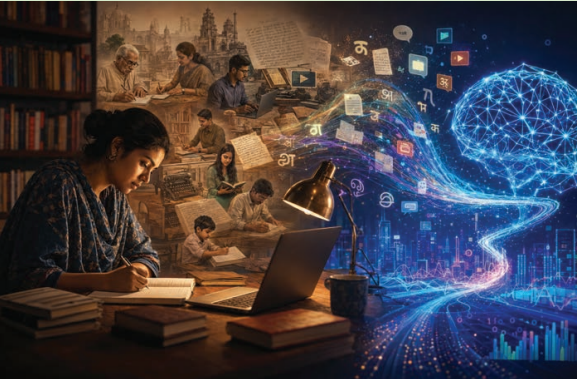
Not very long ago, if someone had asked me what the most powerful communication tool in the world was, I would have answered without hesitation: Video. The communications industry had become almost entirely driven by visuals. Reels, short-form videos and highly visual storytelling seemed to dominate everything from journalism to public relations to branding. Organisations increasingly measured success through visibility, impressions and virality. The assumption was simple: People no longer had the patience to read.
And honestly, for a while, it seemed true.
Today, however, I believe we may be entering a very different phase; one where writing could become more important than ever before, precisely because of the rise of Artificial Intelligence.
AI has quietly seeped into almost every aspect of our lives. We use it casually now. It helps us draft emails, repair appliances, generate recipes in our kitchens, summarise reports, organise our calendars and increasingly perform tasks that once required specialised human expertise. Entire pieces of code can now be generated within seconds. What once took teams days or weeks can suddenly be done in minutes.
Yet beneath all the excitement around AI, there is one crucial reality we are not discussing enough: AI can only function because human beings have spent decades writing.
Every AI platform we use today has been trained on enormous amounts of human-created material: books, essays, research papers, news articles, interviews, policy documents, blogs, journals, websites and archives accumulated over years. AI does not independently “know” things. It learns patterns from what human beings have already documented and shared with the world.
And this is exactly why the future of writing matters so deeply. Because if human beings gradually stop producing original written content, AI itself will eventually lose relevance. Machines cannot endlessly learn from recycled information. Without fresh human thought, new analysis, original storytelling and continuous documentation, AI systems risk becoming closed loops- repackaging older knowledge rather than learning from a living, evolving society.
This has enormous implications for communication and public relations, especially in India.
Over the last decade, communication strategies became increasingly focused on speed and visibility. Brands and institutions moved towards highly visual formats because they worked well on digital platforms. Written communication often became secondary. Long reports were replaced with infographics. Nuanced explanations gave way to catchy captions. Thought leadership slowly lost ground to instant engagement.
But AI may now force organisations to rethink this approach.
Because while videos capture attention, written content creates memory.
A reel may trend for a few hours. A carefully written article, report, speech or policy paper, however, becomes part of an archive. It becomes searchable, retrievable and referenceable years later. Most importantly, it becomes part of the knowledge ecosystem future AI systems will learn from. In many ways, organisations that continue investing in serious writing today are not simply communicating with present audiences. They are helping shape the intellectual datasets of the future.For India, this conversation becomes even more significant because of our extraordinary linguistic diversity. For years, English dominated most conversations around digital communication and global visibility. Yet, India’s true intellectual richness has always existed across multiple languages and regional cultures. Malayalam publishing, Hindi journalism, Bengali literature, Tamil commentary, Marathi essays, Urdu poetry and countless other regional traditions have continuously documented local realities, emotions and social change in ways that cannot simply be replicated through translation tools.
AI can certainly translate a Turkish sourdough recipe into Hindi within seconds and give a hack for baking in warmer climates. But language is not merely information. It carries humour, memory, emotion, local context and cultural nuance- in the case of bread- what is missing is the environment and peer experience derived from experience in similar climatic conditions- not something that ChatGPT can churn out.. Human beings create those layers through lived experience and continuous writing. Machines only process what already exists.
This is precisely why India’s multilingual writing culture matters so much in the age of AI. If original writing in regional languages declines, we do not merely lose vocabulary. We lose ways of seeing the world.
Ironically, some recent trends suggest that people instinctively understand the continued value of written content, even in a hyperdigital world. Publishing in India is not declining but thriving. Malayalam publishers are reporting strong growth, literary titles are seeing major print runs and independent bookstores are expanding. These numbers are important not because they prove people are suddenly reading more books. They matter because they demonstrate that society still values written content. Even in an era dominated by scrolling and shrinking attention spans, people continue searching for depth, permanence and thoughtful expression.
Perhaps this is because we are beginning to experience digital fatigue. Or perhaps because AI-generated visuals and synthetic content are making audiences increasingly sceptical of what they see online. The more artificial the digital world becomes, the more valuable authentic human-created writing may appear.
And that is why organisations should be careful not to abandon writing in favour of visuals alone.Visual communication will continue to dominate attention. India will remain one of the world’s most visually driven digital societies. Reels, videos and AI-generated visuals are not going away, nor should they. But visibility is not the same as knowledge.
A reel may trend for a few hours. A thoughtfully written article, report, speech, research paper or commentary, however, becomes part of a larger human archive. It documents how societies think, evolve, disagree and imagine their futures. Most importantly, it becomes part of the knowledge ecosystem that future AI systems themselves will learn from.
If humanity gradually stops producing original written thought and relies increasingly on machine-generated summaries and recycled content, we risk entering an age where algorithms endlessly remix the past while genuine new knowledge slowly declines. That would not be innovation. It would be stagnation disguised as progress.
Which is why, in the age of Artificial Intelligence, humanity’s greatest responsibility may not simply be to build smarter machines, but to continue contributing original human thought, memory and experience to the world.
Because AI cannot train itself on silence.
Sunanda Rao Erdem is a strategic communications advisor and columnist focusing on technology, diplomacy, and global public affairs.
Share This: